I am Rebecca from Kvalifik, a Copenhagen-based digital agency working on Webflow, strategy, websites and AEO. I did not start Kvalifik. I bought into it and became a partner because I saw one shift coming clearly: websites were turning from brand brochures into strategic growth platforms. The way people find answers is changing again, and that changes what a website has to do.
This is the guide I wish more companies read before they buy a tool or generate a hundred blog posts.
Key takeaways
- AEO is the next evolution of SEO, not a separate discipline. The fundamentals still decide everything.
- The order matters. Technical foundation first, then content coverage, then content quality, then authority, then measurement across all of it.
- Do not let AI be the source of your AEO content. Use it to sharpen expertise, never to invent it.
- Big company does not equal good AEO. Across our work, clients with under 250 employees outperform far larger brands.
- Real proof from our own tracking: we took a Danish heat pump brand from 0.5% to 11.6% AI visibility in 13 weeks, and a universal-design client appears in 65.2% of the AI responses we track. (Updated Aug. 14 2026)
- Proof the method works: our own data-backed awards article earned 2,667 Google impressions and around 200 AI citations in its first week, across all four major engines.
- Traditional search volume is forecast to fall 25% by 2026 as people move to answer engines (Gartner). The window to get cited is now.
What is answer engine optimization (AEO)?
Answer engine optimization is the practice of making your website easy for AI answer engines to find, understand, trust and cite. Where classic SEO optimized for rankings and clicks, AEO optimizes for inclusion in the answer itself, inside tools like ChatGPT, Claude, Perplexity and Google AI Overviews.
The simplest way I explain it: SEO got you onto the page of blue links. AEO gets you into the answer that now sits above those links, before the user ever clicks anything.
It is not a new trick. It builds on the same foundations as SEO. Can your site be crawled? Can your content be understood? Does it answer the questions people actually ask? Is it better and more specific than the alternatives? Do other credible sources confirm it? Can your claims be verified? Get those right and AEO follows. Skip them and no tool will save you.
Why this matters now
The interface for discovery is changing fast. Google AI Overviews already reach more than 2 billion monthly users across 200-plus countries (Google, via TechCrunch). ChatGPT passed 800 million weekly users in early 2026 (Quantumrun analysis). And when an AI Overview appears, only about 8% of searches end in a click, down from 15% when it does not (Pew Research, via Digiday).
That is the structural shift. More buyers are getting their answer without visiting a single website. So the question is no longer only "do we rank?" It is "are we part of the answer before the buyer ever reaches our site?"
This is not only a B2B software story. It reaches ordinary purchases too, which brings me to a ladder.
A real example, one ladder at a time
Recently I was renovating my apartment and needed a multiladder, the kind that works as a platform, a step ladder and an extension ladder. I started where everyone starts. On Google I found page after page of Denmark's biggest home-renovation retailers, names like Silvan, Stigefabrikken and BilligVVS. A few products even caught my eye in Google Shopping, and those were the ones I actually wanted to buy.
Then I clicked in. The product pages did not confirm the things I needed: the working height, the weight, the platform size, whether it fit my specific situation. I am not a ladder expert. I needed the page to tell me it would work, and it could not.
So I asked an LLM instead and described the real situation, ceiling height and all. Out of everything on the market, only two ladders came back with enough detail to answer my questions with confidence. They were not even my favourites. But they were the only two I could verify would actually fit. When I asked about other models by name, the tool could not find enough detail to compare them. I bought one of the two it recommended.
That was the moment it clicked. This was a normal consumer product, not complex software, and AI still decided the purchase. Some of the biggest retailers in the country were selling exactly the right ladders. They simply were not structured to be the answer for my use case, so they never made my shortlist. The products I liked most lost the sale to the two that were easiest to verify. If you think your category is not being researched in AI tools, you may already be wrong.
The hot take: do not write your AEO content with AI
Here is my strongest opinion, and it is not anti-AI. BUT AI should not be the source of your AEO content.
LLMs are trained on what already exists. So if you ask one to write your article from scratch with no original input, it produces a confident blend of everything already online. That makes your content less citeable, not more. It says everything and nothing at once. It is fluent, but empty. No named examples, no numbers, no tradeoffs, no point of view a competitor could not publish in five minutes.
If a model is choosing which source to cite, it is not looking for the fiftieth version of the same explanation. It needs something specific, useful and verifiable. That material almost always already exists inside your company. What do your experts know that competitors do not? What do buyers ask sales every week? What can you prove with cases, numbers and named examples?
So use AI as the editor, the researcher, the structure assistant. Do not let it be the expert. For AEO, the value is not the paragraph. It is the evidence behind the paragraph.
The five layers of AEO, in order
People want to jump straight to schema and tools. The order is the whole point. Each layer only works if the one beneath it is solid.
Layer 1. Technical foundation
You cannot be cited if you cannot be crawled. Crawlability means search engines and AI bots can reach your pages, follow your links and understand your structure. If important pages are blocked, set to noindex by mistake, orphaned, buried, duplicated or slow, they are unlikely to make it into any answer.
It is not a one-time checkbox. Every new template, redirect, localization or redesign can change it. In our audits, roughly 80% of incoming clients arrive with plugins or setups already breaking their old site. Across migrations we typically recover around 40% in Lighthouse performance before touching a single design element. For Pædagogernes Pension and its 125,000 members, a zero-disruption migration moved the Lighthouse score from 68 to 98.
Then there is schema. Schema is the structured meaning you add to a page so machines understand what the content is and who it comes from. For Webflow builds I almost always use JSON-LD, because it sits separately from the visible layout, connects cleanly to CMS fields and scales across templates without breaking when the design changes. Map the schema to the page type. Organization for the company, Article for posts, Person for authors, Product for products, Service for services, FAQPage for real Q&A. Adding Organization schema once and calling it done is the most common mistake I see.
Layer 2. Content coverage
Coverage asks a simple question. Does your website answer the prompts your buyers actually use? In SEO we thought in keywords. In AEO we think in questions and full prompts. People no longer search "best ladder." They describe a 3.2 metre ceiling and a staircase and ask what to buy.
If your site does not answer the real prompt, someone else becomes the answer. The fix is to build a prompt list from sales calls, support tickets, Search Console, customer interviews and live testing in ChatGPT, Perplexity and Google. Group the prompts by buying stage. Then check, honestly, which ones your site answers clearly and which it does not. The gaps are your roadmap.
Layer 3. Content quality
Coverage gets you to the right questions. Quality decides whether your answer is good enough to be trusted and extracted. Five checks I run every time:
Lead with the answer, then explain, then prove, then expand. Write at a grade 5 to 6 reading level, because clear writing is easier for both humans and machines to use. Define your terms plainly, because "X is..." is far easier to cite than a vague description. Structure important pages around real questions people ask. And make everything specific, with examples, numbers, use cases and named outcomes. Specificity is what makes content hard to copy, and hard to copy is what gets cited.
Weak content says "we build scalable websites." Strong content says "we rebuilt Veo's Webflow platform across 8 languages and 800+ pages with a reusable component system, which let their marketing team build 80% of new landing pages without a developer". Same claim. Only one is citeable.
Layer 4. Authority
You can say anything about yourself on your own site. Authority is what the market confirms about you, and answer engines weigh it when deciding whom to trust. It is a pattern of signals: third-party mentions, backlinks from relevant sites, press, awards, named customer testimonials, expert authors, consistent entity information across the web.
Schema supports authority but does not create it. A useful detail to know is sameAs, which links a Person or Organization entity to its verified profiles like LinkedIn or Crunchbase, so machines understand that the Rebecca here is the same Rebecca there. It is a clarity signal, not magic. The proof underneath still has to be real. If you are starting from zero, do not fake it. Turn customer wins into specific case studies, ask for named testimonials, get listed on partner pages and publish expert-led content from real people inside the company.
Layer 5. Measurement
You cannot improve what you do not test. Before optimizing anything, find out whether you appear at all. Which prompts trigger you, which do not, which competitors show up instead, which sources get cited and whether the claims about you are even accurate. Track it as a visibility score across your priority prompts, but treat it as directional. The tools are still early. Imperfect visibility data still beats guessing.
What our data actually shows
This is the part most agencies will not publish. We have run 17 AEO projects, and here is what the tracking looks like.
A Danish heat pump brand, from 0.5% to 7.5% in 7 weeks. We started working with a heat pump company seven weeks ago. Across the 40 prompts we track for them, their AI visibility moved from 0.5% to 7.5% in that window. Early, but the direction is clear and fast. After 13 week the Danish heat pump brand is now at 11.6%.
Kvalifik's own visibility, from 8% to 21% in two months. We track ourselves the same way we track clients. On the 22 decision-stage prompts we monitor, the ones where buyers are picking their final shortlist of agencies, we now appear in 28% of the 84 tracked responses. Honestly, you may have landed on this very page because of that work. Worth a thought, and worth thinking about what the same approach could do for you. After 3 months, the data is now showing 29.6% visibility for Kvalifik.
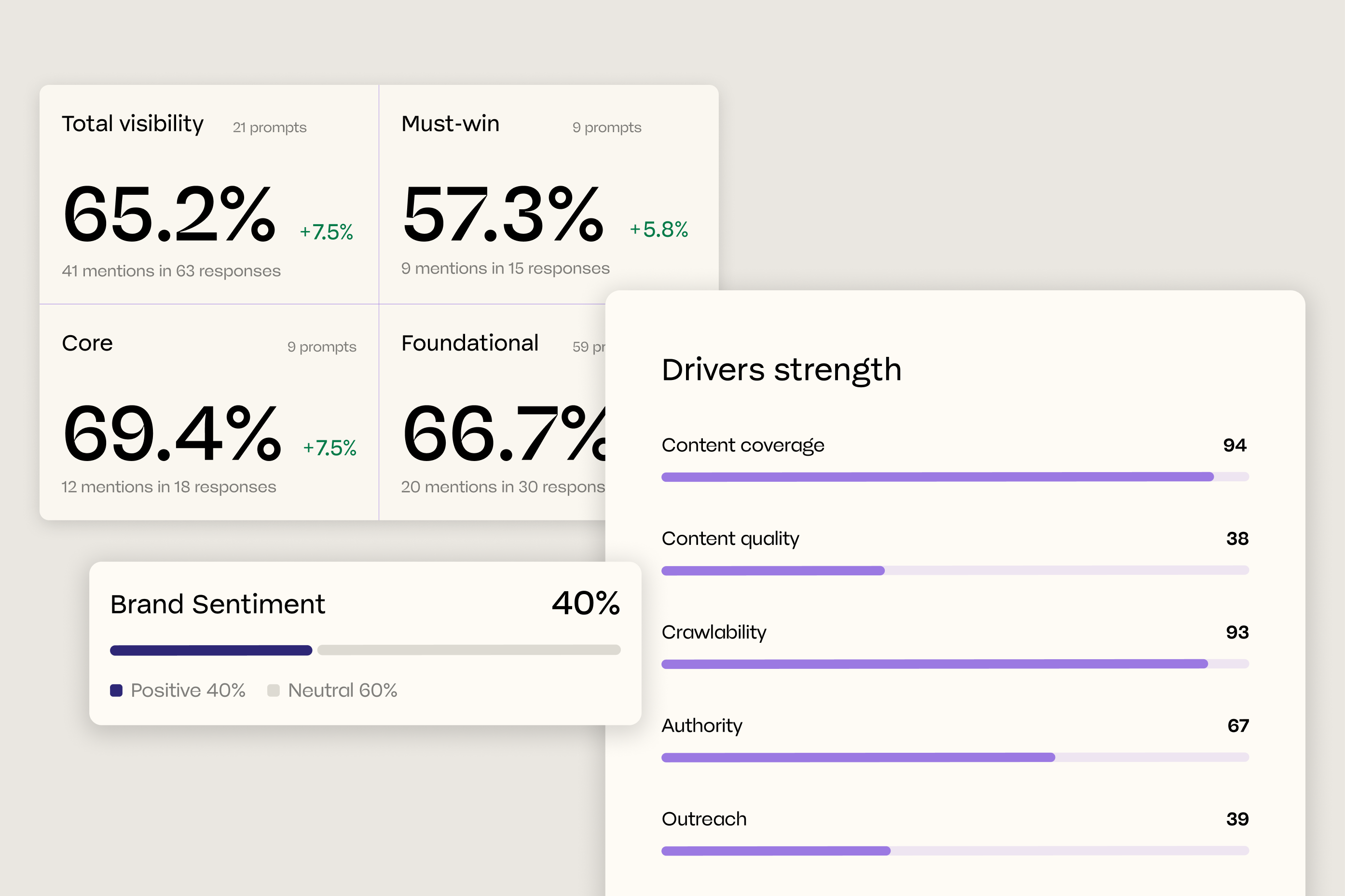
A universal-design thought leader at 65.2%. Our client Bevica Fonden appears in 65.2% of the AI responses we track, which is 41 mentions across 63 responses, and shows up in 21 of 30 tracked prompts. That is not luck. They have a genuine knowledge hub, strong named thought leaders, real publications, and a site that is 100% crawlable with strong external authority. To push them past 65.2%, the next moves are content quality, the clearer definitions, key takeaways and question-led headings from the checklist above, plus outreach so more authoritative sites cite them as experts.
Big company does not equal good AEO. Look back at our client base. About 10% have more than 1,000 employees, 9% have 250 to 1,000, 20% have 51 to 250, 21% have 16 to 50, and 40% have fewer than 15 people. Some of our strongest AI visibility belongs to clients with under 250 employees. Size buys budget. It does not buy citeability. Specific, well-structured, verifiable expertise does.
Proof we practise what we preach. We recently published our own data-backed article ranking the best Webflow agencies, built on original analysis and honest proprietary numbers. In its first week it earned 2,667 Google impressions and was cited roughly 200 times across ChatGPT, Claude, Perplexity and Google AI Overviews. Not because we gamed anything. Because it offered unique content, original data and proof other pages did not have. That is the entire method in one example, and you can apply the same approach to your own pages.
Which AI engines matter for your industry?
One pattern we see clearly across our projects, and it should shape where you spend effort. We track ChatGPT and Claude for almost everyone, then add Perplexity and Google AI Overviews where it fits. Who your buyer is decides which engine matters most.
So before you optimize, know which engine your actual buyer is asking. The answer is rarely all of them equally, and the content that wins on Perplexity is not always the content that wins in ChatGPT.
The Kvalifik AEO Checklist, 10 things you can do today
This is the checklist we run on client pages. Start with your five pages closest to revenue, the service pages, product pages, comparison pages and high-intent guides, and work through it. Most of these a non-developer can fix this week.
- Lead with the answer. Move the key definition, answer or value proposition into the first paragraph. Answer first, explain second, prove third, expand fourth.
- Write for grade 5 to 6. Shorten sentences, one idea each, plain language. Clear writing is easier for humans and machines to reuse.
- Define your terms. Add simple "X is..." sentences near the top of the page. Vague descriptions are hard to extract and cite.
- Use question-led structure. Turn important sections into the real questions buyers ask, then answer each one directly underneath.
- Show dates. Add a visible published or last-updated date wherever freshness matters, and only when the page was actually reviewed.
- Attribute the author. Name the author, role and company, so both people and machines can see who stands behind the expertise.
- Add a key-takeaways block. End long pages with a short, scannable summary of the main points.
- Replace claims with proof. Swap "we build scalable websites" for specific numbers, named clients and concrete outcomes.
- Link internally. Connect each key page to related cases, guides, services and author pages, with descriptive anchor text.
- Match schema to the page. Organization for the homepage, Article for posts, Person for authors, Product, Service and FAQPage where they fit. In Webflow, JSON-LD is the easiest to manage and scale.
You do not need to become an engineer. You need to understand the foundation well enough to spot the gaps and brief them properly. Every "no" on this list is a fix waiting to happen.
Summary
The way people search is changing, but the fundamentals still decide who wins. AEO is not a hack or a tool or a pile of AI-generated pages. It is a forcing function for better websites, clearer content and provable expertise.
Get the order right. Make the site crawlable, answer the real questions, write specifically enough to be trusted, earn authority outside your own walls, and measure whether you are actually showing up. Do not let AI invent your expertise. Let it sharpen what you already know.
The companies that win in AI search will not be the ones publishing the most. They will be the ones whose expertise is the easiest to find, understand, verify and cite. We have the data from 17 projects to back that, and we are happy to show you ours.
Sources
- Gartner, search engine volume to drop 25% by 2026
- Google AI Overviews reach 2 billion monthly users (TechCrunch)
- AI Overview click-through data, Pew Research (via Digiday)
- ChatGPT weekly active users and AI adoption data
All visibility percentages, project counts and client results are Kvalifik's own tracking data across 17 AEO projects.
FAQs
Partly, and that matters. AEO is the next evolution of SEO, not a replacement. The fundamentals still hold: crawlability, indexation, content quality, authority, structure and intent. What changed is the interface. People ask full questions, and results are becoming answers. SEO is not dead. The output is shifting from rankings and clicks to citations and inclusion.
Use AI to structure, summarize, edit and repurpose. Do not use it as the source of expertise. The raw material, the examples, data and point of view, has to come from inside the company. Otherwise you publish generic content that gives no model a reason to cite you.
I would not call it a ranking factor. I would call it a clarity signal. Schema helps machines understand your page and supports rich results, but it does not make weak content strong or create authority on its own. It works best when it reflects strong, visible content.
Because much of AEO sits between content, design, CMS structure and technical implementation, and Webflow lets marketing teams move fast across all four. Scalable CMS templates, structured content, JSON-LD through custom code and reusable components make quality easier to maintain. A well-structured Webflow site is a strong AEO foundation. A messy one is not. The setup decides it.
Pick 20 high-intent questions your buyers ask before they buy, then check whether your website answers each one clearly. Not vaguely. Clearly. The gap between what buyers ask and what your site answers is your starting point, before any tool or redesign.
Test it. Take 10 real buyer questions and ask them in ChatGPT, Claude, Perplexity and Google. See who appears and who gets cited. If competitors are there and you are not, that is a risk. If nobody shows up well, that is your opening.