Webflow vs Adobe Experience Manager
Webflow and Adobe Experience Manager Sites can both deliver polished digital experiences, but they sit in different classes of software. Webflow is a managed visual website platform designed for fast production by design and marketing teams. AEM Sites is an enterprise content platform for complex, global, multi-channel experiences, often within the wider Adobe ecosystem. The choice depends less on feature count than organizational complexity: AEM coordinates more brands, markets, and content operations, while Webflow removes more of the cost and coordination required to keep a focused marketing site moving.
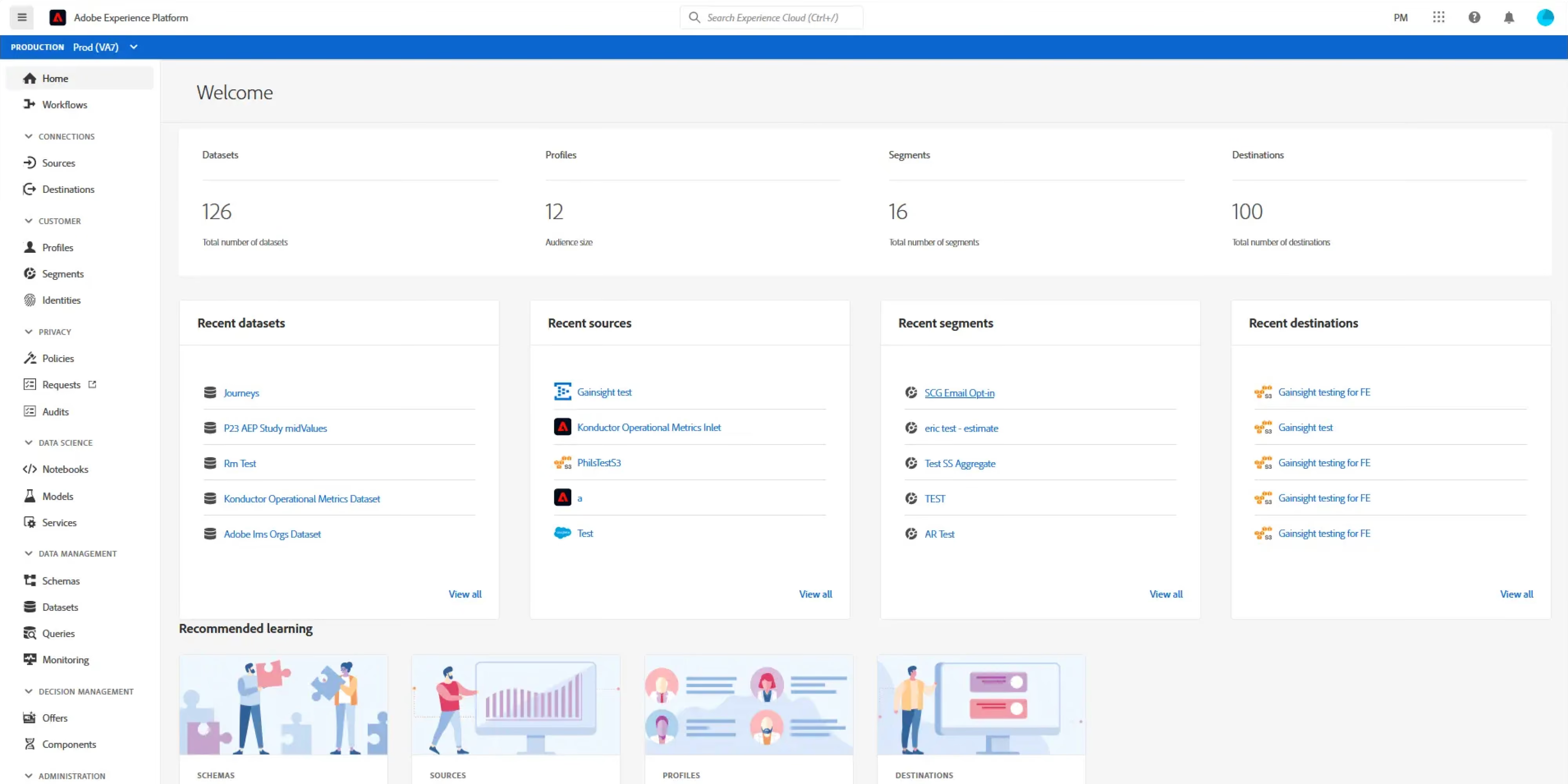
Adobe Experience Platform dashboard showing overview metrics including 126 datasets, 12 profiles, 16 segments, and 100 destinations. The screen is divided into sections for recent datasets, sources, segments, and destinations, each listing recent entries with icons and links. A left sidebar menu categorizes navigation options such as Connections, Customer, Privacy, Data Science, Data Management, Decision Management, and Administration. The top bar includes a search box, user initials, and notification icons. The bottom section shows recommended learning modules with illustrations for Schemas, Sources, Profiles, and Destinations.
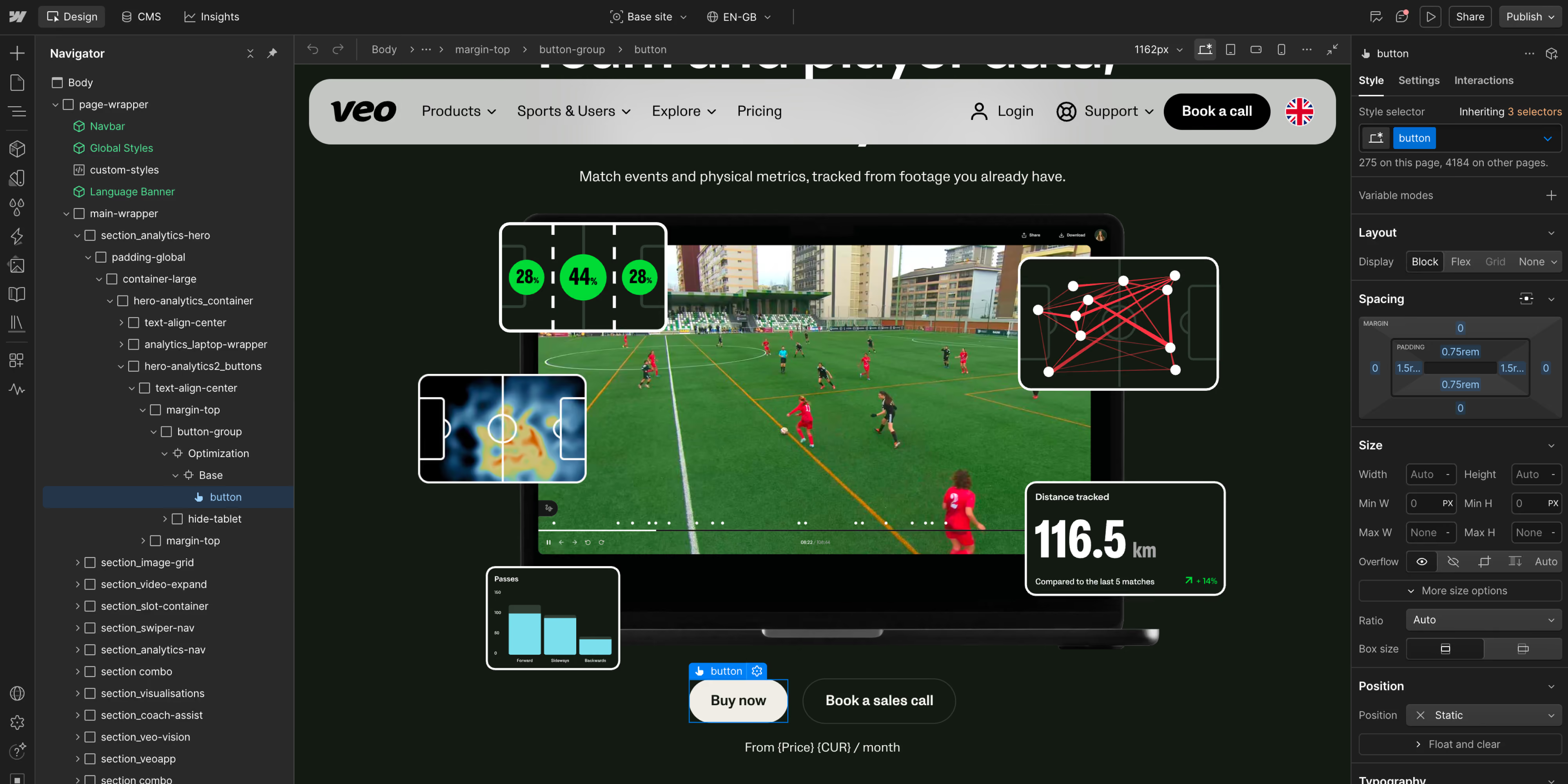
Screenshot of a webpage design interface displaying a sports analytics dashboard for tracking player metrics on a soccer field. The dashboard shows player positions, heatmaps, distance tracked of 116.5 km, and various data visualizations overlayed on a video of a soccer match, with interface panels and style options on the sides. Buttons labeled 'Buy now' and 'Book a sales call' are visible below the video.
50
The short version. Choose Webflow when the priority is a high-quality marketing site, direct visual control, and a faster operating model. Choose AEM when global multi-site governance, omnichannel structured content, enterprise workflows, Adobe integrations, and advanced personalization justify a large implementation and platform team. AEM is disproportionate for many scale-ups, but replacing it may remove essential capabilities for a global organization already using Adobe Experience Cloud across markets and channels.
key takeaways
  • 01
    Webflow is a focused website platform; AEM is an enterprise content and experience platform.
  • 02
    AEM has a higher ceiling for global governance, structured omnichannel content, localization workflows, and Adobe ecosystem integration.
  • 03
    Webflow usually gives a smaller team more direct control and a shorter path from design to production.
  • 04
    AEM pricing is custom. A realistic comparison must include licensing, implementation, integrations, cloud services, support, and the internal platform team - not just a software quote.
  • 05
    A migration is only sensible after feature usage is audited. If the organization relies on AEM’s multisite, assets, headless delivery, personalization, or workflow capabilities, those functions need a deliberate target architecture.

The honest difference

Webflow is the simpler choice for a marketing-led website. AEM is built for enterprises that need to govern content and experiences across many brands, regions, properties, and channels.
Webflow combines design, CMS, hosting, CDN, and publishing in a single managed environment. It is built to shorten the distance between brand intent and the live website. Designers can control the responsive front end; marketers can manage content and approved page structures; developers can extend the platform where needed.

AEM Sites is built for a different problem: managing experience at enterprise scale. Adobe positions it around reusable content, editable templates, multi-site management, translation workflows, structured content, headless delivery, APIs, events, integrations, and personalized experiences. Its cloud service adds managed updates, autoscaling, monitoring, disaster recovery, and enterprise service commitments.

AEM programs commonly require solution architecture, component development, release management, governance, integrations, training, and specialist partners or internal teams. That investment can make sense at enterprise scale, but it can be excessive for a corporate marketing site that mainly needs to publish high-quality pages faster.
Side by side
Webflow
AEM
Product scope
Visual website platform, CMS, hosting, and optional optimization/localization products
Enterprise CMS and content delivery platform within Adobe Experience Cloud
Primary users
Design, marketing, content, and front-end teams
Enterprise content teams, developers, architects, regional teams, and platform owners
Design workflow
Native visual canvas with responsive and interaction controls
Template- and component-led authoring. Visual/headless options depend on architecture
Multi-site and localization
Supported through plans, workspaces, and localization products
Core enterprise strength with multisite and translation workflows
Headless and omnichannel
APIs and external architectures are possible. Website remains the center
Structured content, GraphQL, APIs, events, and multi-channel delivery are central capabilities
Personalization
Available through Webflow products and integrations
Deeply connected to Adobe personalization and customer-data products
Digital assets
Native site asset management. External DAMs can integrate
Advanced asset workflows usually involve AEM Assets and the wider Adobe stack
Hosting and operations
Managed by Webflow
Managed cloud service with enterprise operations. Implementation still requires ownership
Pricing*
Public self-serve plans plus quoted Team/Enterprise
Custom quote
Best fit
Marketing-led sites and focused web portfolios
Global, multi-brand, multi-market, regulated, or omnichannel enterprises
*Pricing is not directly comparable. Seats, add-ons, contacts, multiple sites, enterprise requirements, and implementation can change the total substantially.

Where Webflow wins

Webflow wins when a smaller team needs to launch and improve a high-quality marketing site without an enterprise platform program.

Design, development, CMS configuration, and publishing live close together, reducing handoffs. A strong component system can give marketers autonomy while protecting the brand.

The organization still needs strategy, content, analytics, integrations, governance, and quality assurance, but not the same application architecture or specialist platform capability as an AEM program. For a scale-up or autonomous business unit, that focus can be more valuable than theoretical breadth and make campaigns or pages easier to ship outside an enterprise release process.

Where AEM wins

AEM wins when a global enterprise must coordinate structured content, assets, governance, and personalization across many brands, regions, and channels.

It is built for content reuse across channels, shared asset and translation operations, detailed governance, and connections to enterprise customer-data and journey tools.

It also supports APIs, events, CI/CD, monitoring, service commitments, and security processes around a mission-critical digital estate. Adobe can connect content with analytics, customer profiles, personalization, and campaign orchestration in ways that require several products around Webflow. The cost is justified only when these capabilities are actively used.

Screenshot of a webpage design interface displaying a sports analytics dashboard for tracking player metrics on a soccer field. The dashboard shows player positions, heatmaps, distance tracked of 116.5 km, and various data visualizations overlayed on a video of a soccer match, with interface panels and style options on the sides. Buttons labeled 'Buy now' and 'Book a sales call' are visible below the video.Adobe Experience Platform dashboard showing overview metrics including 126 datasets, 12 profiles, 16 segments, and 100 destinations. The screen is divided into sections for recent datasets, sources, segments, and destinations, each listing recent entries with icons and links. A left sidebar menu categorizes navigation options such as Connections, Customer, Privacy, Data Science, Data Management, Decision Management, and Administration. The top bar includes a search box, user initials, and notification icons. The bottom section shows recommended learning modules with illustrations for Schemas, Sources, Profiles, and Destinations.

Where Webflow wins

Webflow wins when a smaller team needs to launch and improve a high-quality marketing site without an enterprise platform program.

Design, development, CMS configuration, and publishing live close together, reducing handoffs. A strong component system can give marketers autonomy while protecting the brand.

The organization still needs strategy, content, analytics, integrations, governance, and quality assurance, but not the same application architecture or specialist platform capability as an AEM program. For a scale-up or autonomous business unit, that focus can be more valuable than theoretical breadth and make campaigns or pages easier to ship outside an enterprise release process.

Screenshot of a webpage design interface displaying a sports analytics dashboard for tracking player metrics on a soccer field. The dashboard shows player positions, heatmaps, distance tracked of 116.5 km, and various data visualizations overlayed on a video of a soccer match, with interface panels and style options on the sides. Buttons labeled 'Buy now' and 'Book a sales call' are visible below the video.

Where AEM wins

AEM wins when a global enterprise must coordinate structured content, assets, governance, and personalization across many brands, regions, and channels.

It is built for content reuse across channels, shared asset and translation operations, detailed governance, and connections to enterprise customer-data and journey tools.

It also supports APIs, events, CI/CD, monitoring, service commitments, and security processes around a mission-critical digital estate. Adobe can connect content with analytics, customer profiles, personalization, and campaign orchestration in ways that require several products around Webflow. The cost is justified only when these capabilities are actively used.

Adobe Experience Platform dashboard showing overview metrics including 126 datasets, 12 profiles, 16 segments, and 100 destinations. The screen is divided into sections for recent datasets, sources, segments, and destinations, each listing recent entries with icons and links. A left sidebar menu categorizes navigation options such as Connections, Customer, Privacy, Data Science, Data Management, Decision Management, and Administration. The top bar includes a search box, user initials, and notification icons. The bottom section shows recommended learning modules with illustrations for Schemas, Sources, Profiles, and Destinations.

Which should you choose?

Ask: is the website a focused marketing channel, or one surface in a global content and customer-experience system?
Choose Webflow if
  • A relatively small team needs to own and improve the site quickly
  • Brand expression and visual control matter more than enterprise omnichannel orchestration
  • The website can integrate with specialist tools instead of living inside one suite
  • You want to reduce platform complexity and the number of specialist roles required
Choose AEM if
  • You manage many markets, brands, sites, languages, channels, or regulated workflows
  • Reusable structured content and enterprise governance are strategic requirements
  • Adobe Experience Cloud is already a core part of your customer-data and marketing architecture
  • You have the budget, traffic, teams, and processes to realize the value of the platform
AEM is rarely proportionate for a smaller standalone marketing site, where Webflow offers less overhead and a shorter implementation path. Webflow also fits most scale-ups unless multinational, multi-brand, regulated, or omnichannel needs are already central. At enterprise scale, AEM can coordinate global estates and Adobe-led experience programs, while Webflow can remain the better platform for a distinct corporate, campaign, or venture site that needs autonomy.
AEM offers more enterprise content, integration, and governance flexibility. Webflow gives the people building the website more immediate design and publishing flexibility. AEM’s flexibility is architectural and organizational; Webflow’s is operational and creative.
AEM is strongest in large financial services, retail, travel, healthcare, manufacturing, telecommunications, and other global or regulated organizations with complex content operations. Webflow is strong for B2B SaaS, technology, professional services, growth companies, and design-led brands. The deciding factor is usually scale and operating complexity rather than industry alone.
Questions
Webflow can replace AEM for a focused marketing website when enterprise capabilities are unused or can be handled elsewhere. It is not a direct replacement for a global AEM program that depends on multisite management, omnichannel content, Adobe personalization, complex assets, or enterprise workflows.
AEM addresses a wider and more complex enterprise problem. Cost can include custom licensing, implementation, cloud services, integrations, component development, migration, support, and an internal platform team. The price should be assessed against the scope it replaces or enables, not against a self-serve website plan.
For direct visual control and fast page production, Webflow is generally easier. AEM can support sophisticated enterprise authoring, approvals, localization, and reuse, but the experience depends heavily on the component library and implementation created for the organization.
AEM is stronger when personalization is connected to Adobe’s customer data and journey products across an enterprise. Webflow can support testing and personalization through its own products and integrations, but it is not a complete substitute for a mature Adobe Experience Cloud program.
Both can support strong SEO. AEM can meet complex enterprise requirements through configuration and development; Webflow makes common controls more accessible to a smaller web team. Search and AI visibility depend on crawlable, useful, well-sourced content and sound implementation, not the purchase price of the CMS.
Yes, for sites whose actual needs fit Webflow. Start with an inventory of templates, components, content types, languages, assets, URLs, redirects, workflows, search, forms, integrations, personalization, and analytics. Decide which capabilities should be retained, replaced, simplified, or retired. AEM Assets and other Adobe products may remain even when a website moves.
Considering moving a site from AEM to Webflow?
Tell us where it hurts.
We will identify which complexity is essential, which is historical, and whether a simpler platform will genuinely improve the way your team works.
Get in touch