Conversion (CRO)
Conversion optimization for sites that keep getting better after launch
Conversion rate optimization (CRO) is the ongoing work of understanding why visitors don't act, then testing changes to your site until more of them do.
By Rebecca Busk, CEO & Partner
Last updated: June 2026
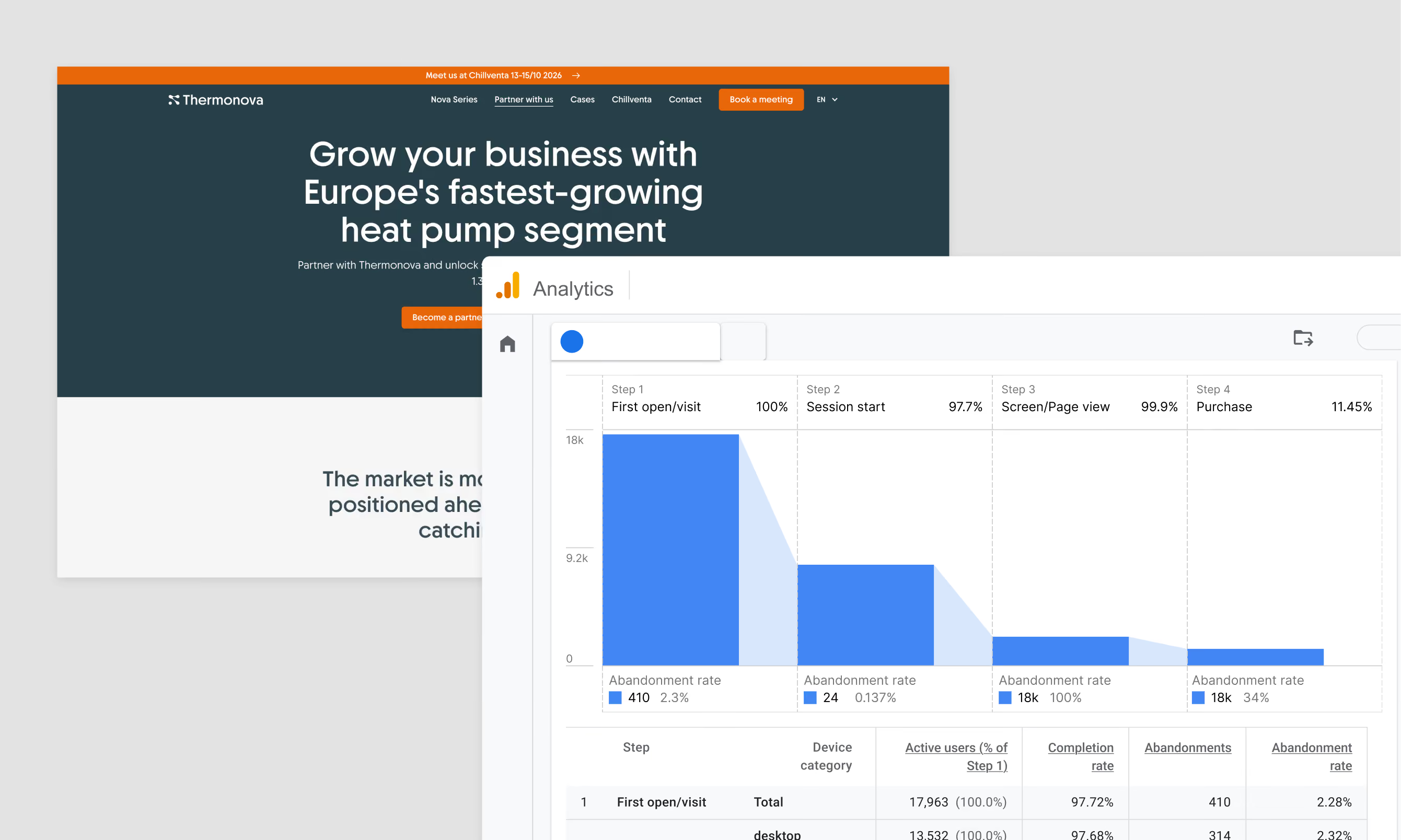
Good CRO means more of the people already on your site book, sign up, or buy, without buying more traffic.
We look at where people come from, what they're trying to do, and where they give up. Then we redesign, test, and ship the version that wins.
We work in a rhythm, not a one-off audit. Test, learn, iterate, so the site keeps up with how your customers actually behave.
What is conversion rate optimization?
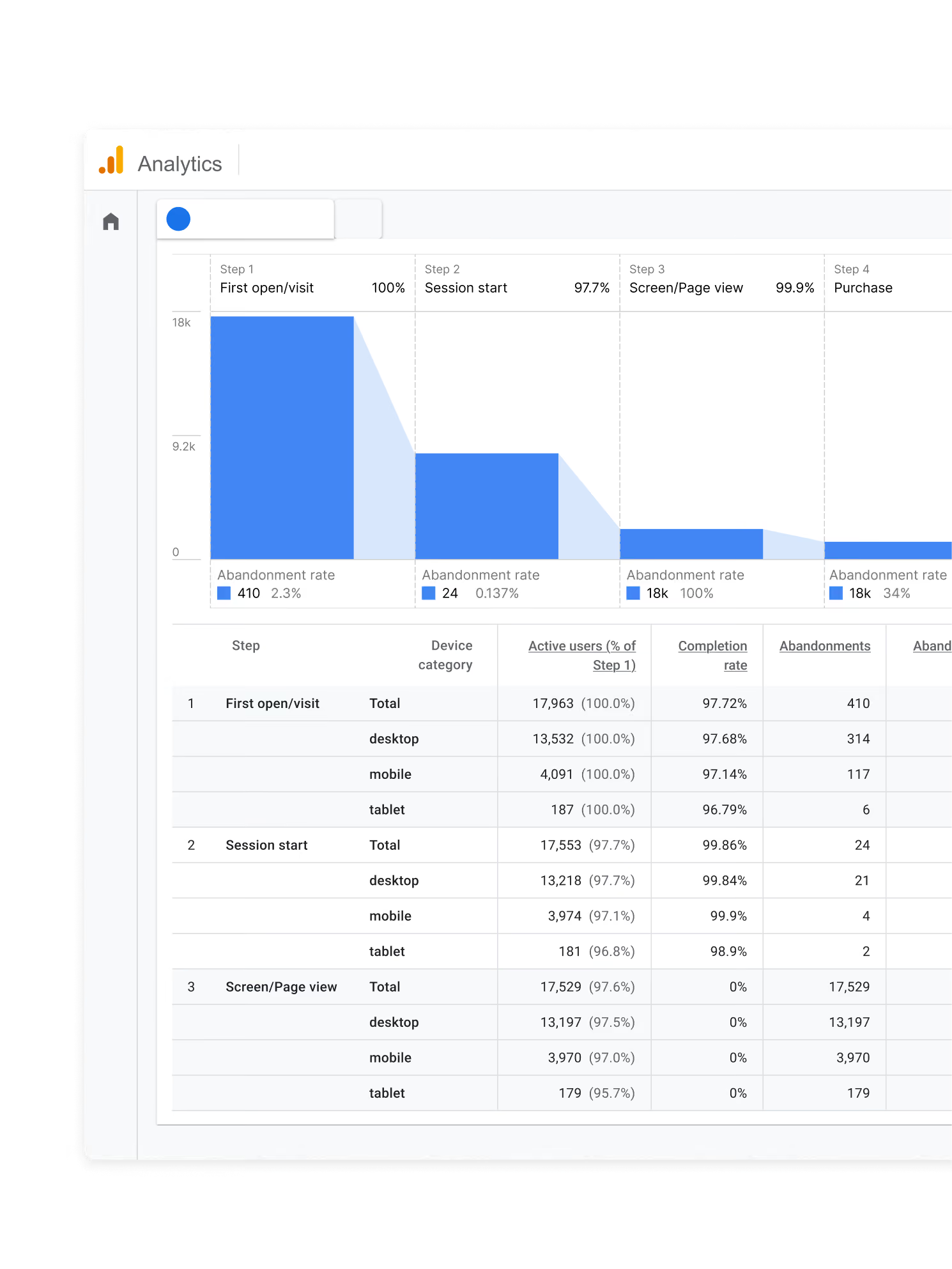
Conversion rate optimization is the practice of increasing the share of visitors who take the action you want, whether that's booking a demo, signing up, or buying. It combines analytics, user research, design, and A/B testing to find out what's stopping people and fix it.
The work goes well beyond button colors. It's rethinking the journey, testing new page designs, rewriting the offer, updating the sitemap so people land in the right place, and building new experiences for the intent people arrive with. Done well, CRO turns the traffic you already pay for into results you can measure.
Who is this for?
We run CRO for teams whose site gets traffic, but not enough of it turns into anything:
- 01You're paying for traffic that bouncesAds and content bring people in, and most of them leave without doing anything.
- 02The site launched, then nobody touched itIt looked great on launch day. Eighteen months on, the market moved and the site didn't.
- 03You have opinions, but no testsEvery design debate is settled by the loudest voice in the room instead of by data.
- 04Different visitors, one generic journeyA first-time visitor and a returning lead see the same page, and neither gets what they came for.
That's marketing-led scale-ups, B2B companies with a long consideration phase, and anyone whose website is a real sales channel. If you have too little traffic to test on yet, we'll say so, and start with the journey and the analytics instead.
Redesign every few years, or improve every month?
The big redesign | Continuous optimization |
|---|---|
Everything changes at once, based on best guesses and internal taste. | One change at a time, based on what visitors actually do, so you know what worked. |
Results show up months later, and nobody can say which decision made the difference. | Results show up in weeks, with a clear winner and a clear loser for every test. |
It's right when the brand, the platform, or the structure is broken beyond patching. | It's right when the foundation holds and the numbers should be moving. |
Most sites don't need another redesign. They need someone to look at the data, form a hypothesis, and test it. Then do it again next month. That's what we do, and when the foundation really is broken, we'll tell you that instead.

What's included in CRO
A test-and-learn loop your site never had
- Journey and intent analysisWhere people come from, what they're looking for, and where they drop off, from analytics, heatmaps, and session recordings.
- Hypotheses and test planA prioritized list of what to test first, based on impact and effort, not opinion.
- A/B tests and new designsNew page designs, layouts, and copy, built and tested against the current version.
- New experiencesLanding pages, flows, and personalized journeys for the intents your site doesn't serve yet.
- Sitemap and structure updatesReworking navigation and page structure so people land where they meant to.
How we work
Four steps, no mystery
- 01MeasureWe set up tracking that actually answers questions, then map where visitors come from, what they're trying to do, and where they give up.
- 02HypothesizeEvery drop-off becomes a testable idea. We rank them by expected impact and effort so the first tests are the ones most likely to move the number.
- 03TestWe design and build the variant, run the A/B test until the result is significant, and keep the version that wins. Not the one someone liked more.
- 04IterateWinners get rolled out, learnings feed the next round, and the sitemap and journeys get updated as we go. The loop runs every month, not every three years.
Questions
Conversion rate optimization (CRO) is the practice of increasing the share of visitors who take a wanted action on your site, such as booking a demo, signing up, or buying. It works by understanding user intent, forming hypotheses about what stops people, and testing changes until more of them act. Done properly, it is an ongoing loop rather than a one-off audit.
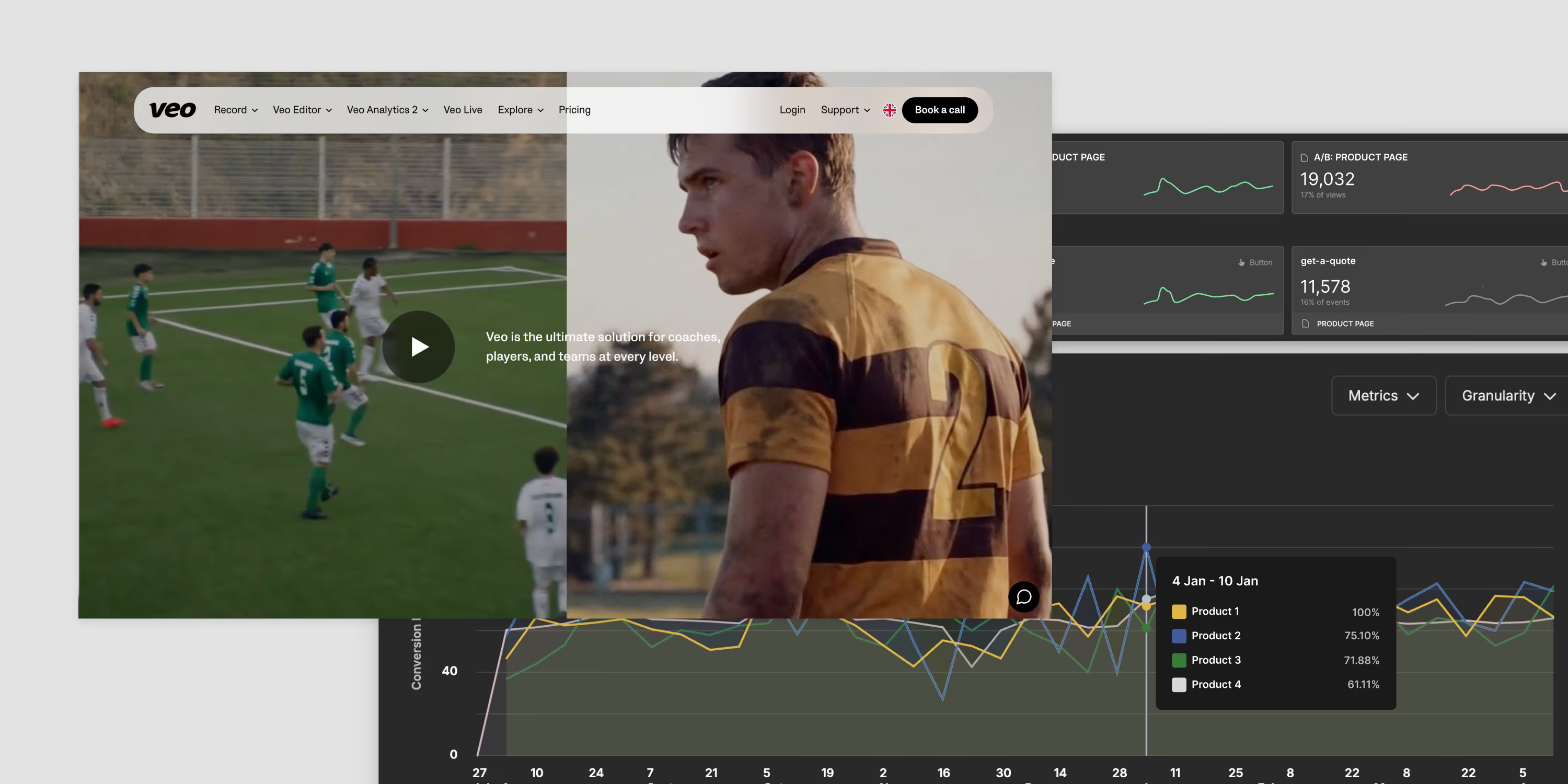
It depends on where you start, but the gains are often larger than another round of ad spend. For Veo, sport-specific personalization alone lifted conversion by 17%, and the wider program of new pages and journeys grew demo bookings by 170%. A single test rarely does that. A steady rhythm of tests does.
We show two versions of a page to different visitors at the same time and measure which one gets more people to act. The test runs until the difference is statistically significant, so the result reflects real behavior and not a lucky week. The winner becomes the new baseline, and the next test starts from there.
Ongoing. A one-off audit gives you a list of things to fix. A CRO program gives you a rhythm where something is being tested every month, winners get rolled out, and the site keeps improving between redesigns. Most clients run it as a monthly retainer with a fixed number of tests and new experiences per cycle.
You need enough conversions, not just enough visitors, for a test to reach significance in reasonable time. As a rule of thumb, a few hundred conversions a month on the page you're testing is comfortable. Below that, we lean more on user research, session recordings, and bigger structural changes you can measure before and after, and less on split tests of small tweaks.
Everything. Someone arriving from a comparison search wants to see how you stack up. Someone clicking a retargeting ad has already decided and wants the shortest path to the form. When both land on the same generic page, both convert worse. A big part of CRO is matching pages, journeys, and messaging to the intent people arrive with, and building new experiences for the intents you don't serve yet. Read about digital strategy.
It changes what gets in the way of people acting, not who you are. Some tests are small, like a form field or a headline. Others are new page designs or a reworked navigation. Every variant is built inside your design system, so a winning test looks like it was always part of the site. If a test would compromise the brand, we don't run it. See how we approach digital experience design.
We work with whatever you already have where it makes sense, and add what's missing. That typically means analytics such as GA4, heatmaps and session recordings, an A/B testing and personalization tool such as Webflow Optimize, and your CRM for closing the loop on lead quality. On Webflow sites, most variants and new pages can be built and shipped without a developer, which keeps the test cadence high. See why we build on Webflow.
think we
might be a fit?
might be a fit?
Tell us where it hurts.
We'll give you a straight answer, even if it's not us.
We'll give you a straight answer, even if it's not us.
Let's talk